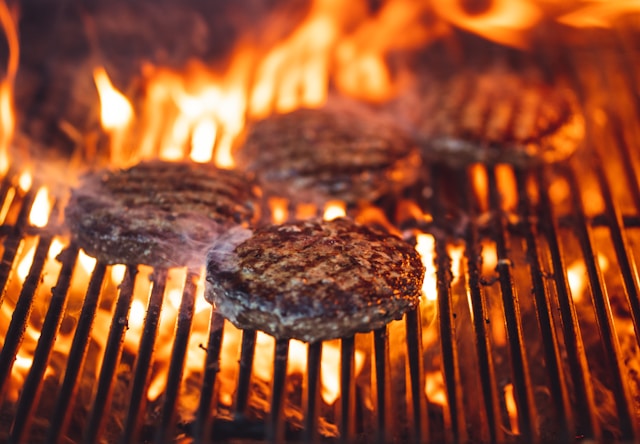
A standard beef burger, roughly 2cm thick, takes 3 to 4 minutes per side on a BBQ preheated to 200–230°C. That gives you 6 to 8 minutes total for a medium cook.
Your patty thickness, the BBQ’s temperature, and how done you want it all shift that timing. Thicker patties take longer. A BBQ that isn’t fully preheated leaves the centre raw, even when the outside chars up. And when you’re cooking mince rather than a whole cut, internal temperature matters in a way that colour and char can’t tell you.
The beef itself makes a difference, too. Mince with around 20% fat holds together better on the grill and stays juicier through the cook. The best beef for burgers covers that in full if you want to get it right before you fire up.
BBQ Burger Cooking Times by Cooking Level
This table gives you a guide to your cooking level and how you like your burgers by time per side, total cook time, and internal temperature in one place.
| Cooking Level |
Time per Side |
Total Cook Time |
Internal Temp |
| Rare |
2–3 min |
4–6 min |
49–51°C (120–125°F) |
| Medium rare |
3 min |
6 min |
54–57°C (130–135°F) |
| Medium |
3–4 min |
6–8 min |
63–68°C (145–155°F) |
| Medium well |
4–5 min |
8–10 min |
68–74°C (155–165°F) |
| Well done |
5–6 min |
10–12 min |
74°C+ (165°F+) |
All times are based on a beef patty roughly 2cm thick, with around 20% fat content, on a BBQ preheated to medium-high heat (200–230°C).
Give the BBQ the time it needs to reach temperature before anything goes on. Burgers placed on a grill that hasn’t fully preheated will char on the outside before the centre has time to cook through. Most undercooking problems start here, not with the timing itself.
Patty thickness something else that catches people out. The times above are for a standard 2cm patty. Add roughly a minute per side for every extra centimetre of thickness. A patty that looks similar to a 2cm one can easily be 3cm at the centre if it hasn’t been pressed evenly, and that difference shows up on the plate.
Grilling Burgers on Gas and Charcoal
The timing table above applies to both gas and charcoal BBQs. A burger cooks based on the heat hitting it and the thickness of the patty. The equipment is secondary to those two things.
What does change between setups is how you manage that heat.
Gas grills give you the most predictable results. Set the burners to medium-high, close the lid, let the grates preheat and look at the dial until you get to the right heat. Done. The heat stays consistent throughout, so the timings hold without much adjustment.
Charcoal is less forgiving. Once the coals have ashed over and are glowing white, you’re often above 230°C in the first 20 minutes. Then they drop. Your first batch of burgers may cook faster than the next one, sometimes by a minute or more. Check against the timing table rather than assuming each round will behave the same.
The lid question comes up a lot, and the answer depends on what you’re cooking. Closing it turns the grill into a convection oven, circulating heat around the burger from all sides. That suits thicker patties and can reduce the total cook time. Leaving it open keeps the heat direct and radiant from below, which gives you more surface char without the risk of overcooking a thinner patty through.
On any setup, follow the timing table, adjust for patty thickness, and use a meat thermometer if you’re not sure. Gas, charcoal, or anything in between, that approach holds.
What Temperature Should Your BBQ Be for Burgers?
For direct grilling, aim for 200–230°C (400–450°F). That’s medium-high heat, and it gives you enough intensity to char the outside properly while leaving enough time for the centre to cook through before the surface burns.
On a gas BBQ, turn all burners to medium-high and close the lid. Let it run for 10 to 15 minutes before anything goes on. If the built-in thermometer reads 200–230°C, you’re ready.
No thermometer? Hold your palm roughly 15cm above the grate. Three to four seconds before you need to pull away means you’re at medium-high. We’d also recommend using a probe to measure the internal temperature of the burgers to achieve the cooking level you’d like. Read more about that in the next section.
Charcoal takes a little longer to read. Wait until the coals have fully ashed over and are glowing white with no black patches remaining. That typically takes 20 to 30 minutes from lighting. Spread them evenly for consistent heat across the grate. The hand test works here too, same count.
For thicker patties, a two-zone setup is worth the extra minute it takes to arrange. Pile the coals to one side, or keep one bank of burners off on gas, to create a hot direct zone and a cooler indirect zone. Sear the patties over direct heat first, then move them across to finish cooking through. It gives you the char without the outside burning before the centre is done.
Internal Temperatures for BBQ Burgers
Only a meat thermometer tells you what’s actually happening in the centre of a patty. Colour and char tell you what’s happening on the outside. They don’t tell you what’s happening in the centre, and with mince that distinction matters.
Insert the thermometer from the side of the patty, pushing the probe into the middle. Coming in from the top gives you a reading from the surface layers rather than the centre, which is where undercooking actually happens.
Pull the burger 2 to 3°C before your target temperature. It will keep rising off the heat as the residual warmth continues working through the patty. That’s carryover cooking, and ignoring it is a reliable way to overshoot your intended cooking level.
Pull & Resting Temps
| Cooking Level |
Pull At |
Resting Temp |
| Rare |
47–49°C |
49–51°C (120–125°F) |
| Medium rare |
52–54°C |
54–57°C (130–135°F) |
| Medium |
61–65°C |
63–68°C (145–155°F) |
| Medium well |
66–71°C |
68–74°C (155–165°F) |
| Well done |
72°C+ |
74°C+ (165°F+) |
The FSA recommends cooking minced beef until it is “steaming hot all the way through”, with no pink remaining and juices running clear. The guidance exists because bacteria in mince runs throughout the patty, not just on the surface, as it does with a whole cut of beef.
If you don’t have a thermometer handy, gently press the centre of the patty with a finger. Rare feels soft with little resistance, similar to the fleshy base of your thumb when your hand is relaxed. Medium gives some resistance but still has a slight give. Well done feels firm all the way through. It’s a rough guide rather than a precise one, but it’s an alternative to cutting the burger open and losing the juices.
Medium Rare Burger Temperature
Medium rare sits at 54–57°C (130–135°F) at the centre. The patty will have a warm pink interior and noticeably more juice than a well-done burger. Pull it at around 52–54°C and let carryover do the rest.
Bear in mind the FSA guidance above. Medium rare is a common preference, but it does mean serving mince below the recommended 70°C threshold.
Medium Burger Temperature
Medium sits at 63–68°C (145–155°F). The centre will be warm with a slight pink, and this is the most commonly requested cooking level for BBQ burgers. Pull at 61–65°C. It hits the sweet spot between juiciness and the reassurance of a properly cooked patty.
At Honest, we have a ‘Medium Pink Program’ which due to our sourcing of LTTC (less than thoroughly cooked) beef and the practices in our kitchen means that we can serve our burgers ‘Medium Pink’. We cook our classic patties to the medium pink temperature of 67–69°C and this is how we recommend you have them.
Honest’s BBQ Burger Tips
Tips from our very own Head of Food, Adam Layton.
1- Fat is Non-Negotiable.
You can’t fake juiciness over live fire. Run a 20–25% fat ratio minimum—chuck, short rib, and a hit of dry-aged trim if you have it. If the coals aren’t spitting and smoking from rendering beef fat, your blend is a lost cause.
2- Flip Often, Build the Crust.
Kill the “only flip once” myth. Get the grates brutally hot and flip the patty every 15 to 30 seconds. It mimics the heat of a rotisserie, cooking the center evenly while building an aggressive, savory Maillard crust.
3- American Cheese is King
Forget the fancy aged cheddar, it’s just going to split and turn to grease over the coals. The second you make your final flip, slap on a slice of processed American cheese. It’s sliced thin to melt instantly on the hot meat, and the emulsifiers guarantee it drapes perfectly without breaking.
Cooking Burgers Off the BBQ
A BBQ runs hotter and more unpredictably than a controlled hob or oven, which is why the timing guidance earlier in this article is more involved than it would be for indoor cooking.
On a pan or griddle over medium-high heat, a 2cm patty needs around 3 to 5 minutes per side. Cast iron holds heat consistently, so once it’s up to temperature, you get a reliable crust and an even cook. Less variables than a BBQ, shorter learning curve.
An oven at 200°C fan takes 18 to 22 minutes in total. Flip halfway through. It won’t give you the same surface as direct heat, but it’s forgiving on thicker patties and useful when you’re cooking in volume.
Once the burger is cooked, whatever the method, the next call is what goes on top. Our burger toppings guide covers the classics and a few combinations worth trying.
Frequently Asked Questions
How do you know when a burger is done without a thermometer?
The press test gives you a rough idea. A soft centre means rare, firm means well done. But the more useful habit is timing plus observation together.
If the patty has been on a properly preheated BBQ for the full time in the table above and the juices running from it are clear rather than pink, you’re close. Cut into one burger from the batch to check, accept that you’ll lose some juice, and use that as your reference for the rest.
A meat thermometer or probe lets you skip all of the above and keep more of the juices in the patty. Get one if you’re serious about cooking burgers at home.
Why are my burgers raw in the middle?
If the outside is charred but the centre is raw, the heat was wrong before the burger went on, not during the cook. A BBQ that looks ready often isn’t. Check the temperature rather than going by how it looks or how long it’s been on.
Cold patties straight from the fridge compound the problem because the centre takes longer to come up to temperature while the outside carries on cooking. Let the BBQ hit 200–230°C, rest the patties out of the fridge for 15 minutes first, and the timing in the table above will be more accurate.
Should you cook burgers on high or low heat?
Medium-high, around 200–230°C. High heat burns the outside before the centre cooks. Low heat dries the patty out and stops you getting a nice crust. Medium-high gives you char on the outside and enough time for the centre to reach temperature.
How long do you cook burgers on each side?
For a standard 2cm beef patty at medium cooking level, 3 to 4 minutes per side on a preheated BBQ. Adjust up for thicker patties and down for thinner ones. The full breakdown by cooking level is in the timing table above.
Can you eat a burger that’s pink in the middle?
With a whole steak, pink in the middle is fine because harmful bacteria sit on the surface and are killed by searing. With mince, those bacteria spread throughout the patty during grinding, so a pink centre carries a higher risk. We operate a medium-pink program at Honest that means we can serve our burgers pink and we source meat that is certified to be ‘LTTC’ (less than thoroughly cooked).
The FSA recommends cooking burgers until piping hot all the way through, with no pink remaining and juices running clear. Some restaurants serve pink burgers safely using controlled sourcing methods, like us at Honest Burgers. At home, the safer call is to cook to well done.
What’s the best way to cook burgers on a charcoal BBQ?
Wait until the coals have fully ashed over and are glowing white, which takes around 20 to 30 minutes from lighting.
Spread them evenly for consistent heat, or set up a two-zone arrangement with coals on one side for thicker patties.
Use the hand test to check temperature before the burgers go on. Charcoal runs hotter at the start and drops as the coals burn down, so your first batch may cook faster than subsequent ones.
Once the burgers are done, our guide to burger sides covers everything worth putting on the table alongside them.
If you’d rather skip the BBQ and let someone else handle it, find your nearest Honest restaurant now. We’ve been making great British burgers with the best ingredients since 2011. Have a look at what’s on the menu.